Faster, searchable docs: docs.testery.io has moved to a new documentation platform with faster page loads, built-in search, and click-to-zoom screenshots. All existing links continue to work.
AI-ready documentation: Every page is now also available as plain Markdown (add .md to any page URL), and the site publishes llms.txt and llms-full.txt, so AI assistants and coding agents can read the Testery docs directly.
Azure DevOps Integration: Connect Azure Repos as a source for your tests and see Testery results as status checks on your pull requests. See Azure DevOps.
JUnit Output for CI Pipelines (CLI 1.20.0): testery report-test-run --output junit writes results as JUnit XML, so CI systems such as Azure Pipelines can publish Testery results natively. See Azure DevOps Pipelines.
Multi-stage test plans: Every stage of a test plan now runs against the same build it started with, and each stage reports its own status back to your pull request.
More reliable test runs: Testery now detects test runners that stop responding or run out of resources and ends them with a clear explanation, instead of letting the run hang for hours. Runs that never got started are also cleaned up automatically.
testery test: A single command that runs your tests the same way everywhere. Run locally by default, or add --remote to run on Testery. Works with Playwright and cucumber-js (auto-detected), and can write results as native output, JUnit, or JSON.
testery whoami: Shows which user and account the CLI is signed in as.
Autofix failed test runs: The new /testery:autofix-failed-test-run command in the Testery plugin for Claude Code diagnoses a failed run, then updates the test, fixes the bug, or files a bug report, one root cause at a time. See Claude Plugin.
Easier CLI sign-in: The new testery login command saves your credentials, so you no longer need to pass --token on every command. Use --profile to switch between multiple Testery accounts.
Improved stability when many test runs start at the same time.
Testery for Claude Code: Install the Testery plugin to create, monitor, and report on test runs, manage environments and schedules, and set up Playwright BDD projects, all from Claude Code. See Claude Plugin.
Mobile and tablet support: The Testery web app now works on phones and tablets, with a mobile menu, stacked layouts on small screens, and automatic navigation collapse on tablets.
Rerun failed tests serially: A new option reruns only the failed tests from a run, one at a time. This is useful for confirming whether failures were caused by tests interfering with each other.
The test run details page has a better layout on mobile devices.
The rerun API now accepts a maximum number of parallel runners for the rerun.
CLI 1.16.0: upload-test-run now accepts a branch and commit, and create-environment --ignore-already-exists-error lets CI pipelines create an environment safely on every run.
Redesigned Integrations page: Integrations now show logos and tags for what each one does (Trigger, Test Runner, Alert), and you can filter by capability. The left navigation has also been refreshed.
Hosted Testery MCP Server: Connect AI assistants like Claude to your Testery account and work with test runs, environments, and pipeline stages in plain language. Sign in with your Testery account through the /mcp command; no API token needed. See Testery MCP Server.
CLI options are now consistent across commands. create-deploy accepts --project-key and --environment-key, and --commit and --branch work as shorter aliases for --git-ref and --git-branch.
Test History: A new Test History view in Analytics and on each test's detail page shows a test's past results, including when it last passed in each environment.
Node.js test stacks now use the npm version that ships with your Node.js version, instead of a fixed npm version, so installs match what you run locally.
Cypress Test Discovery Optimization: Significantly improved the performance and reliability of Cypress test discovery for large test suites. The test finder now handles complex projects more efficiently, reducing the likelihood of timeouts during test enumeration.
Real-time Log Streaming: Added real-time streaming for test run logs. You can now watch test execution logs as they happen, providing immediate visibility into test progress and failures without refreshing the page.
Added the ability to "bookmark" filters on the Test Runs tab. Filters will be saved in the URL which will be used to auto-set these filters again when returning to that URL.
New Feature: Two new tags/hooks have been added to Testery to allow users to run code as setup/teardown steps. Just annotate your code block with @BeforeTesteryRun or @AfterTesteryRun and Testery will run that code before/after the test run. This code will only run once before/after the run, not once on each runner.
New Feature: Users can now create teams within Testery.
Added the ability for users to run scripts before a test run on each runner. Simply add a script named testeryPreRunScript to your package.json and the Testery app will run that script before the test run on each runner.
Fixed a bug causing flay tests to show in the list of failed tests in Slack notifications.
You can now filter your test runs on the Test Run tab by flaky test.
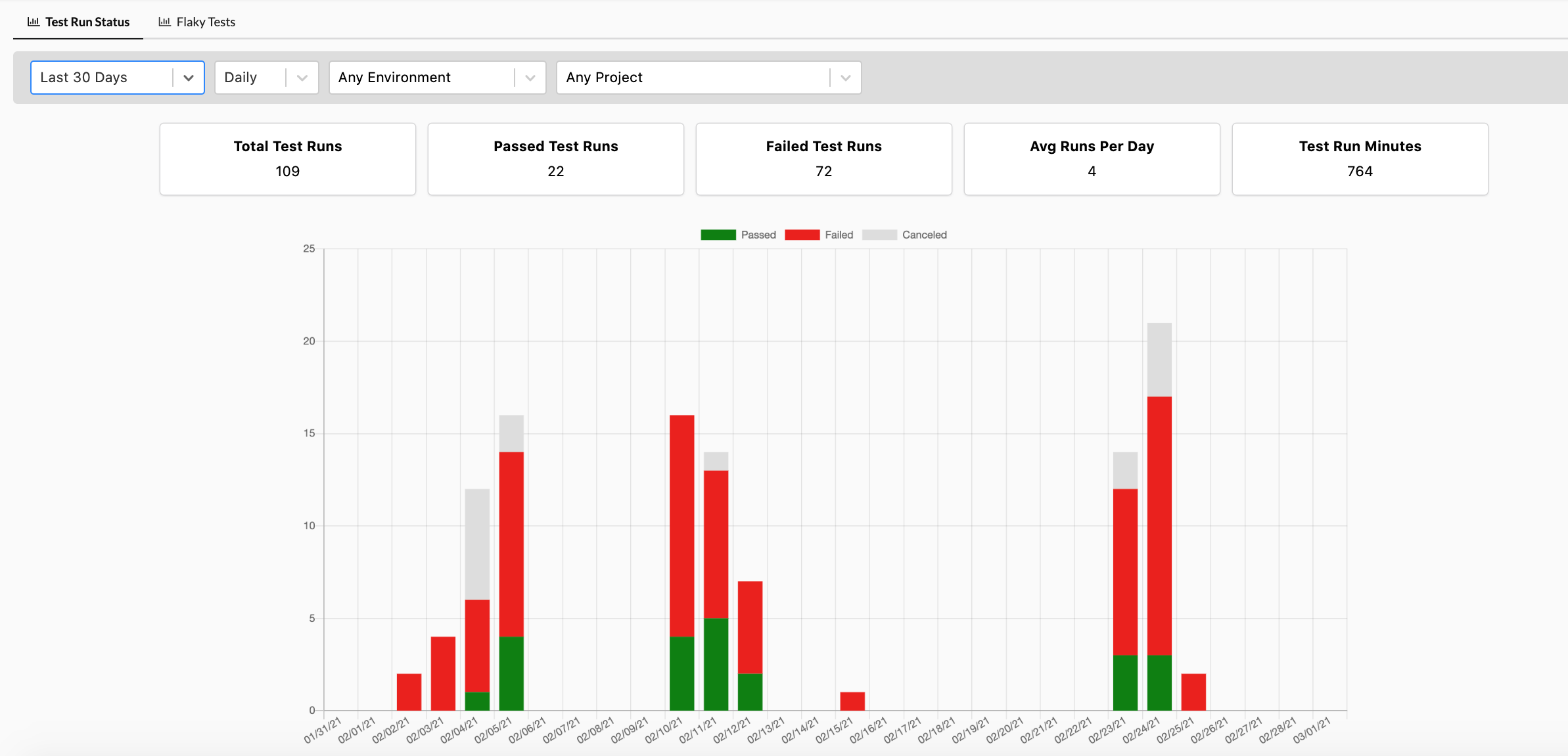
Test run analytics. See a historical view of your test runs and gain insight into how your tests are performing. Filter by time period, environment, project and build.
Flaky tests analytics. See a historical view of your flaky tests and gain insight into the stability of your tests. Filter by time period, environment, project and build.
Changed UI to show all tests (previously only show last test) in a test run when a test or test run is re-run.
Performance improvement: cached calls to reduce page load time
Added project setting for number of default runners. All tests runs for a given projects will default to this unless overidden at test run time.
Added a new alert for 'When test run completes and has flaky test'. This can be setup in Alerts
Added ability to collaborate and leave messages for your team on a test run.
Added ability to follow a test run. Once you follow, you can receive slack or email notifications when a test run moves from queued to submitted status, when a test run completes and when a new message is posted to test run.
Better align screenshots with specific tests. Added option in Project settings that you can turn on which will print the test name to the test output and Testery will match that against the test.
Added npm to the default image that test runners use
Performance improvement: changed UI to only load updated test results on test results page
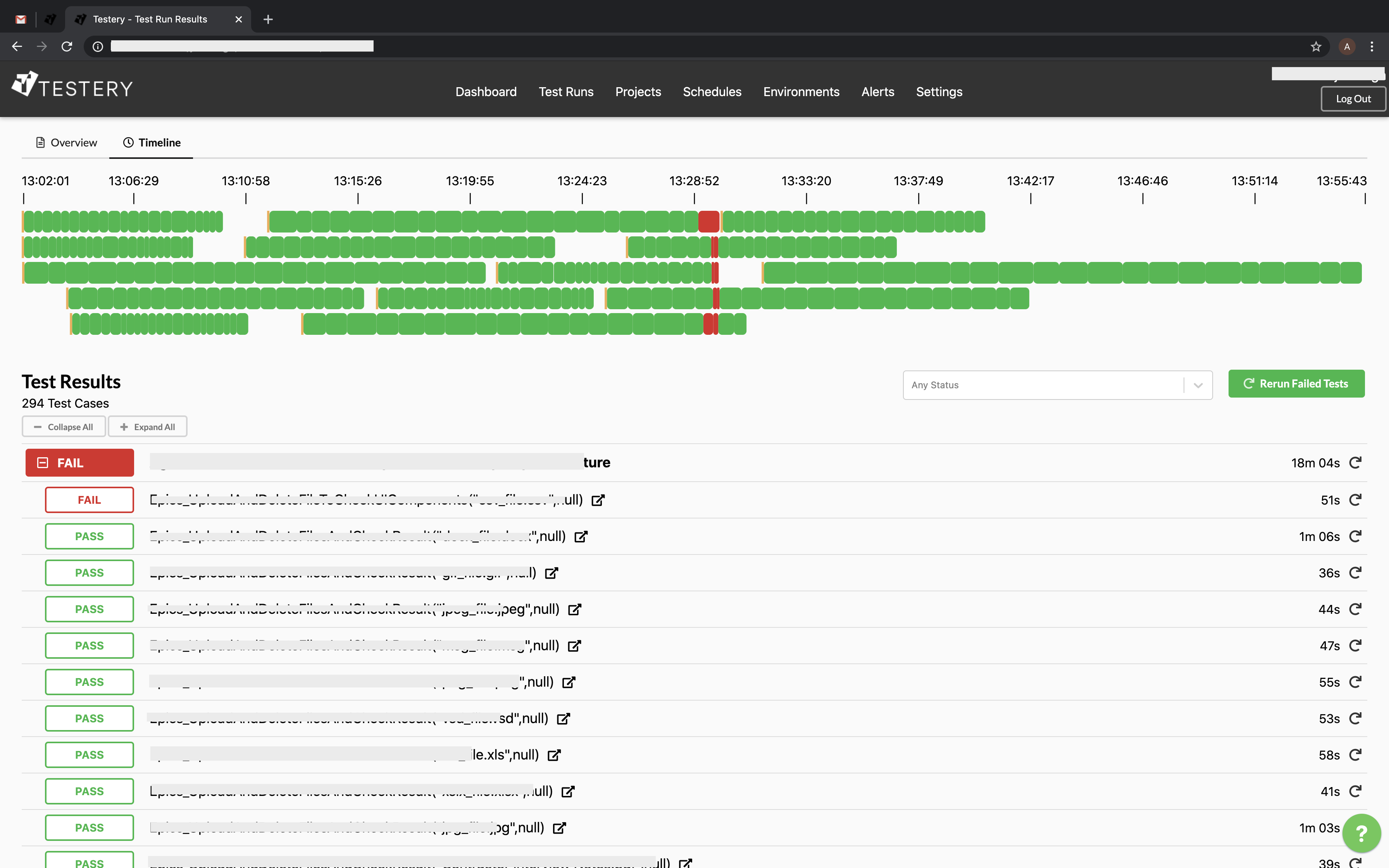
Test run timeline view! Checkout the test run timeline view to see how each test executed. Easily identify any patterns that may be causing issues in your tests or environments. ( see below image)
Added filters to Schedules tab making it easier to find what you need. Filter by project or environment.
Bug fix: we fixed issue running latest version of chrome on Windows servers.
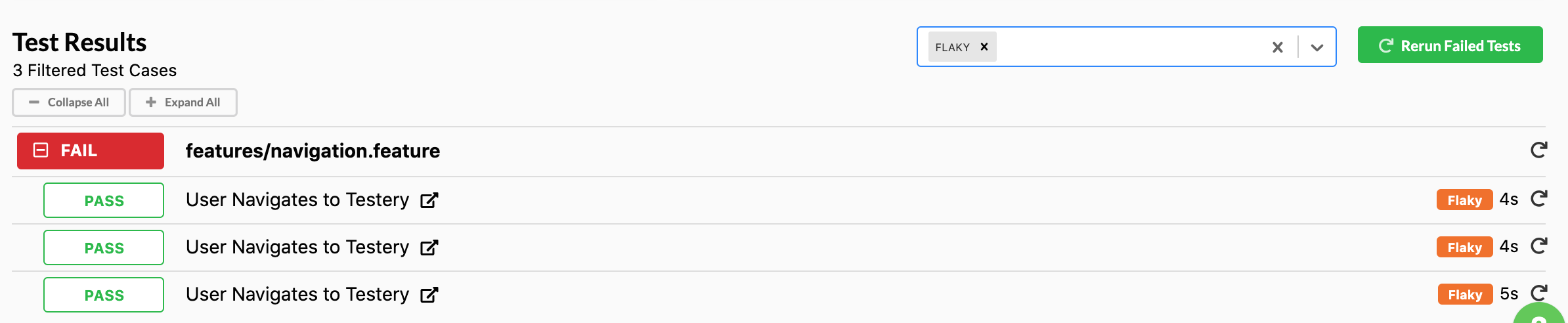
Flaky tests! Testery will now identify when a test is flaky by adding a tag so you can take action. Flaky tests are a nuisance and can cause the team to not trust the results. Testery now helps you make it easy to identify a test that failed once but passed the second time. (see image below)
Added ability to re-run failed tests. There is a setting on a test run now that you can turn on and when tests fail the failed tests will automatically re-run. This helps account for flaky tests and saves your team time.
Added ability to create a Testery account using email (instead of just Github and Bitbucket)
Added a new user invite. When you add a team member they will now receive an invite making the process much more smooth getting into Testery.
Display commit for project that triggered the test. If a test run is triggered by another project deploying and your test code is in a different project, you will now see both projects commit info.
Added test run execution priority. Give a pipeline stage a priority and all test runs within the stage will default to that priority. You can override this at a test run level. Now, more important environments / tests can run before others that are less urgent.
Added commit info for each card on the Environment Dashboard. You can now easily see what code was in the environment at the time the test ran and who committed.
Added ability to filter test results by test status.
Added a not run category in test results so you can see if a test didn't run for some reason.
create-deploy from the CLI now supports the same environment, project and commit but with different build ids.
Added pipeline stages. Pipeline stages represent stages in your development pipeline (dev, test, qa, prod, etc). Each environment can be added to a pipeline stage allowing you to group environments into stages. You can view your projects and test runs by pipeline stage.
We now have an Environment Dashboard!!! See a birds eye view of all your test runs across environments. If you have setup pipeline stages the stages will display in columns with each test run /environment combo in the column. When you click on a test run on the dashboard it will take you into the test run to see more details.
Added a link to your environment. Edit your environment, add the url to your environment and team members can easily access the environment from within test runs.
We made test_run_id available as an environment variable.
Added filters to more easily navigate the environments page when you have a lot of environments.
Added ability to change your password in Settings.
Bug fix: fixed issue when manually running a test run when using "latest deployed version".
Updated configuration to support webdriver.io file being stored in any location.
For Cypress.io, it's a common issue with the framework where chrome will fail to load. We added extra support for this scenario and will automatically re-run the test if chrome fails to load.
Added a "Run Now" button to Scheduled test runs. If you click the run now button the scheduled test run will run immediately.
UI Design: Enhanced how tests display within a file/feature so they are grouped better.
Updated Slack alert to send to notify for all environments and not just a single one.
Bug fix: Fixed issue where a test here or there would get run twice and count as 2 tests in results.
Scheduled test runs is live! You can now schedule a test run to run regularly at a certain day/time or when a deploy happens. (If running a test when a deploy happens you have to send us your deployment information.)
Display branch name to the Source Info box on a test run.
Added support for Bitbucket Server.
Added ability to manually upload test artifacts. A project can now be created with no artifacts associated.
Bug fix: When parallelized by file and re-running failed tests, only re-run the tests in the file that failed.
Bug fix: enhanced how screenshots are associated to a test run
Added ability to configure/override timeout for test runs. You can do now set a default timeout for a single test and the test run at the project level and override at the test run level.
Added ability to parallelize by file for the Nightwatch.js runner
For NUnit tests, allow user to specify to parallelize tests by file or test. When running tests by feature separate out test results by individual test for easier viewing and report errors appropriately.